NOSTRATEMPUS | GAZMEND LEKA | Sign Language A return to the unspoken.
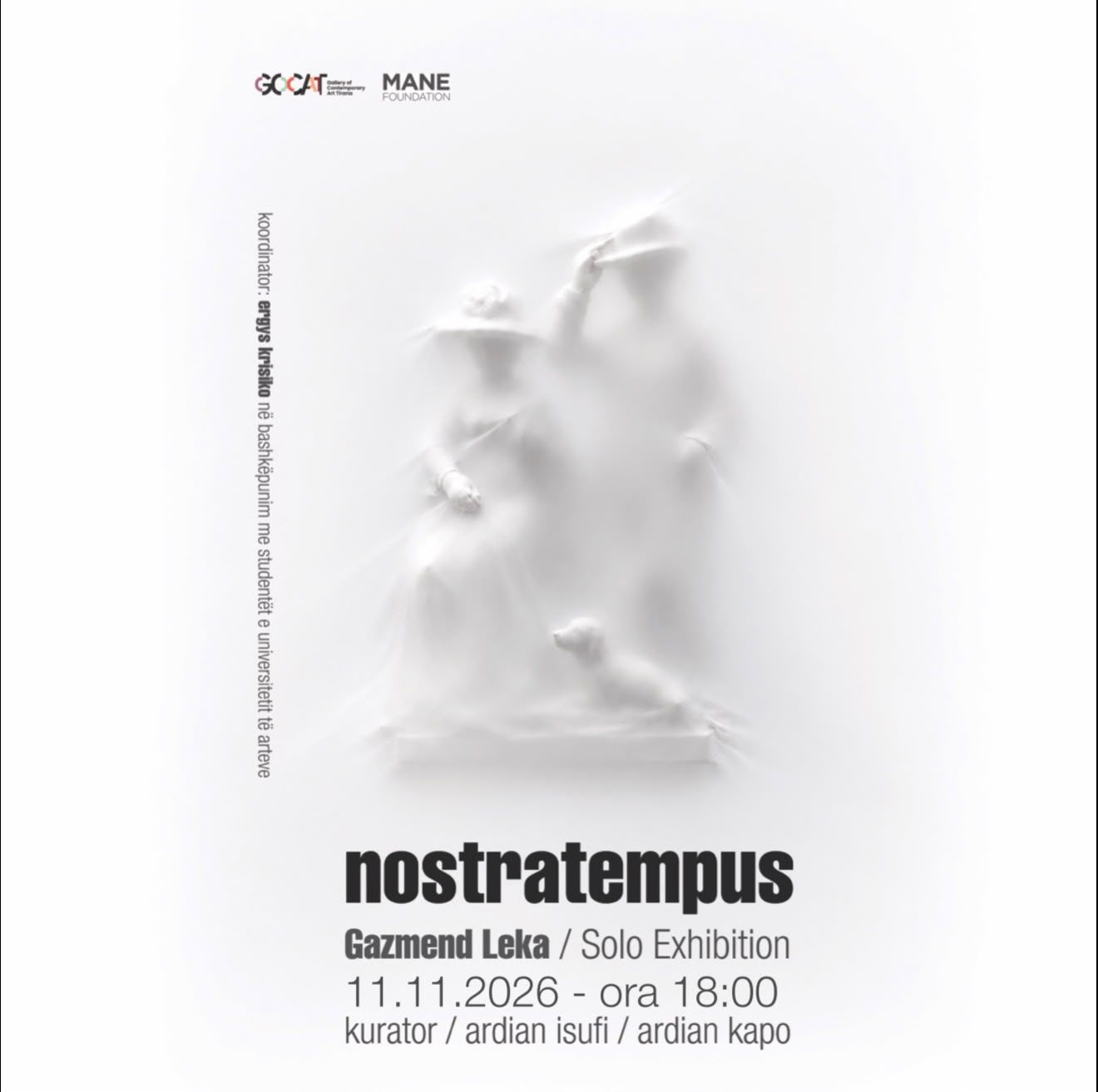
Can art reclaim as evidence what history leaves behind as ruin, and can what appears as a fragment of a lost world become a starting point for a world still unimaginable ?
NOSTRATEMPUS is a mystical map of human memory, from which symbol, writing, and matter form an alphabet of time. Gazmend Leka's visual universe presents the past not as a closed territory and the future not as an untouched horizon, but as two times coexisting in the present of codes waiting to be deciphered and in invisible states that continue to exert their presence.
The intertwining of archaic signs, biological structures, chromatic scales, technological schemes, and mythological symbols creates a language that transcends the boundaries of epochs. "Art does not reproduce the world," in the spirit of Gilles Deleuze, but creates new ways of perception and new connections between elements that previously seemed unrelated. The ancient and the contemporary do not exclude each other, as they interact to produce unexpected meanings.
NOSTRATEMPUS does not only ask what time has been, but what it has marked within us and what we are still able to write upon it.
THE BLACK BOARDS - AXIS MUNDI are layers where knowledge and forgetting, sign and erasure, build a fragile history. The artwork in this exhibition stems from an inner scenario, where art appears as a process of interpreting and transforming culture from ancient calligraphies to analyzed typographies and archetypal signs, up to the contrasts with our present that has passed through the centuries-old body of history to arrive at the body of the work. Formulas, symbols, and fragments of writing resemble the remnants of a civilization trying to decipher itself. Walter Benjamin, in his theses on the philosophy of history, imagines the angel of history turned toward the past, where he sees ruins piling up one upon another, and they do not reconstruct the past as a finished narrative but reveal the fragments that have survived beyond silence.
Black, white, and red
Black creates the depth of an unknown space, white registers the sign, the writing, and the diagram, red appears as an accent of energy, alarm, or biological trace. Color-Sign in this relationship acts as a symbolic code that guides the reading of the image.
The chromatic scale in Gazmend Leka's act in the context of the NOSTRATEMPUS exhibition can be interpreted not simply as a technical organization of colors, but as an active structure of thought, of symbol, and of aesthetic experience. His creativity is placed in a conceptual dialogue with Johannes Itten and Josef Albers, two foundational figures of modernism who treated color as an independent field of artistic and perceptual research.
Johannes Itten - color is constructed through contrasts and equilibria, creating a system where chromatic relationships determine the tension, harmony, and structure of the image.
Josef Albers - color acquires a relative and transformative character, and its perception changes according to context, demonstrating that it does not exist visually as an isolated value but as a relationship that continuously produces new effects.
In Gazmend Leka's work, these two dimensions can be extended toward a symbolic and existential field.
The chromatic scale is not merely an organization of light and intensity; it can become a bearer of memory, of heritage, and of the tensions between presence and absence. In the cycles GENI YNË SHKRUAR NË KUQ & ZI (OUR GENIUS WRITTEN IN RED & BLACK) and DËRRASAT E ZEZA (THE BLACK BOARDS), the writings stand out as visual scripts that transform into a map of human thought, where biology, mythology, number, and symbol attempt to communicate.
Here lies Leka's most interesting possibility: he does not separate knowledge from mystery. On the contrary, he places them face to face. Diagrams suggest that the world can be deciphered, and symbols remind us that not everything can be reduced to explanation. The subject seems to preserve a secret, and writing promises to reveal it without ever completing the process.
NOSTRADAMUS does not function simply as an evocation of the prophet's figure, but as a symbolic structure through which the future appears as an enigma, the present as a moment of interpretation, and the past as an archive of signs waiting to be reread.
Prophecy in this perspective is not necessarily a prediction of what will happen, but a creative act that builds new relationships between image, time, and knowledge. Leka's symbolic language can be interpreted as a system of open signs, where mythological, historical, and archaic references do not offer final answers but activate multiple possibilities of meaning. The image thus becomes a space where the visible and the hidden, the rational and the intuitive, intertwine without dissolving into a single explanation.
NOSTRADAMUS within NOSTRATEMPUS thus becomes a metaphor for the artistic act itself and can be read as an inquiry into the fragile boundary between history, prophecy, and imagination. The exhibition in this sense is not simply a retrospective journey; it is almost a critical act toward the way history is constructed and how society chooses to remember or forget.
The black boards become open archives of consciousness, while the objects of the Nostradamus cycle become relics and warnings of a possible future.
Martin Heidegger emphasizes the human being as a temporal being: "We do not observe time only from the outside; we exist and are structured through it." So if NOSTRATEMPUS places us before what we have inherited, NOSTRADAMUS confronts the dilemmas of what we are preparing for those who will come after us, because time is not only what passes over us, but also what we bear responsibility for.
Curators: ARDIAN ISUFI - ARDIAN KAPO